
Singing our way to sea
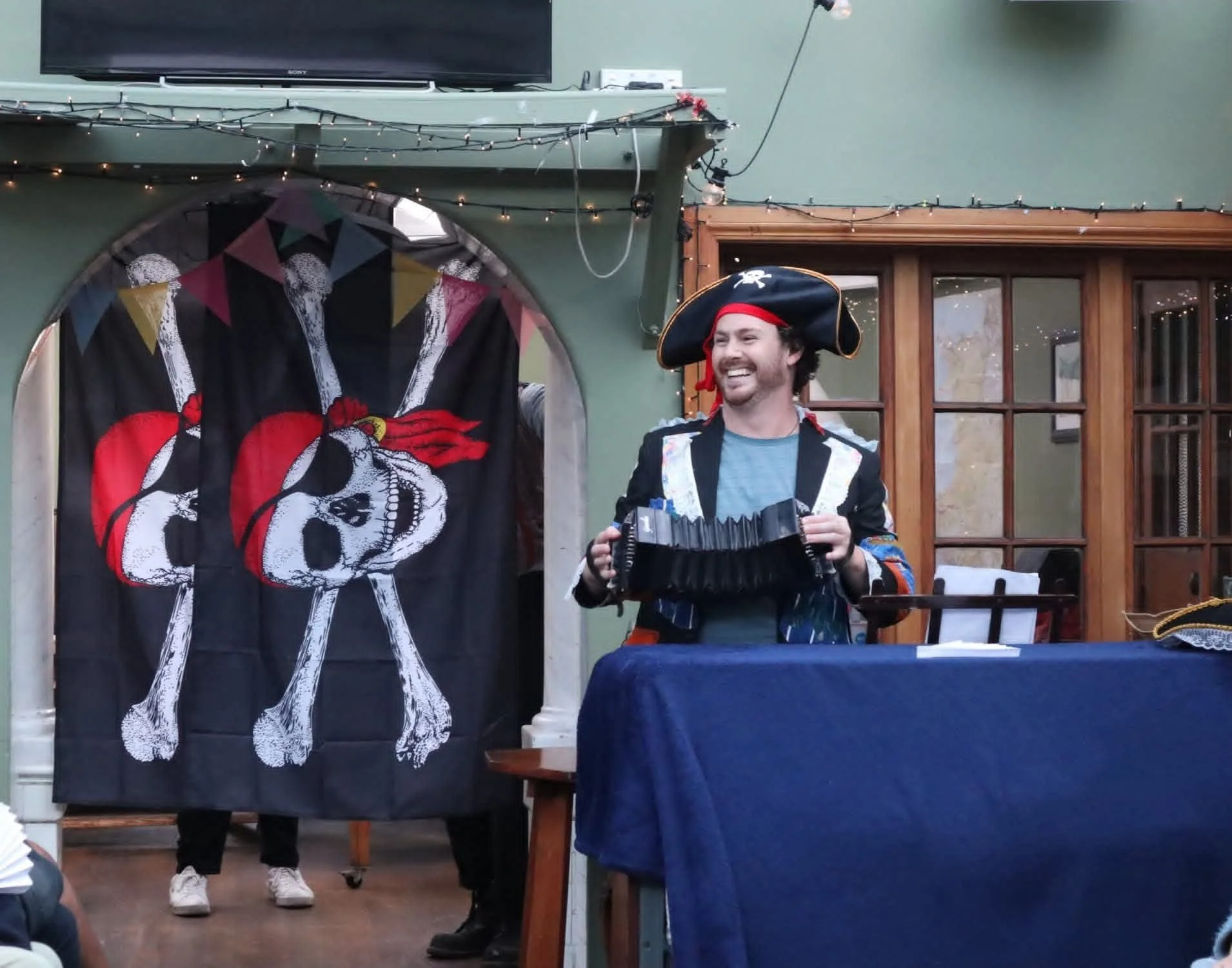
When you talk to Nino Raphael about The Man Whose Mother was a Pirate – The Musical, you don’t just hear about a show he has created. You hear about a lifelong tangle of music, theatre, family, sea shanties, Margaret Mahy (of course), and a very strong belief that art should belong to everybody — especially the people brave enough to sing along.
“This show has been in the works since mid-2022 and it's grown in lots and lots of different ways,” Nino says. “It's quite like the concertina that I play on the show. It bellows out and in, in all different forms, and this variation of the show I am hoping will be the pinnacle which we can then hopefully grow across the seven seas!”
From 5–14 December, that “concertina” of a show will unfurl across The Hannah stage, transformed into a pirate ship for a brand-new musical theatre voyage inspired by Margaret Mahy’s much-loved children’s book. It’s a story about a boy called Sam, his pirate mother, and a call to the sea. In Nino’s hands, it’s also about community, courage, and what happens when you dare to push beyond the comfortable edges of New Zealand theatre.
A life lived between art forms
Nino’s path to this moment has never been a straight line.
“I guess it all stems from me never figuring out or deciding the one discipline that I wanted to do,” he laughs. “We have many facets to us. We have a lot of interests. We creatives can rarely decide on one thing. And that’s ok.”
Nino trained at the New Zealand School of Music as a classical singer, but the list of “and also” is long: theatre, directing, arranging, facilitating music and performance. His father is a choir leader. His mother, Sarah Hoskins, runs the Music Therapy department at the School of Music.
“A lot of those are very much interconnected to things I wanted to do whilst being a performer, and I always wanted to see that connection in community music alongside this difficult thing we talk about, especially in opera, like ‘high art,’ that it's revered all the way up here. It's expensive, it's difficult… And I always thought, well, how can we have the engagement of community music and that art form coming together a little bit more?”
After an MFA in theatre focusing on ensemble and company dynamics, Nino began devising work with actor-musicians; performers who sing, act, and play instruments. “We have very skilled performers in this country who can sing and dance and play a great variety of instruments,” he says. “But we just don't get to see it enough. It's such a big thing if you go to the main stages in the West End and Broadway. It’s always been something I've wanted to do myself.”
That thread — community, complexity, and acting musicianship — runs straight into this musical.
Finding Margaret Mahy in a Lancashire loft
The origin story of this musical doesn’t start in a rehearsal room, or a childhood memory of the book, but in a loft in the north of England.
“I was overseas pushing my own creative boundaries and discovering what is possible, and I found The Man Whose Mother Was a Pirate by Margaret Mahy in my aunt's loft in Lancashire.”
By then, Nino had just seen a string of West End shows, including Matilda, which lit a spark.
“So I put that as a challenge to myself to try to compose something, as well as it being an ode to my own journey,” Nino says.
The connection became personal very quickly.
“My mum would be an amazing pirate mother,” Nino grins. “So it’s a bit of a love letter to my mum and everything she does, trying to inspire creativity in others.”
Mahy’s story, with all its whimsy and steel, gave Nino the perfect vessel. “That's what this story essentially is. Sam is going to the sea with his mum and trying to combat all the patriarchal naysayers… And combating all of those things that I think everyone fears, and feels.”
Sea shanties, a Welsh pub, and a room full of strangers singing
One of the show’s biggest innovations is also one of its simplest: getting the entire audience to sing. That seed was planted back in Pōneke, at the Welsh Dragon pub.
“A friend said I should go with them to the Welsh Dragon pub because they do a sea shanty night,” Nino recalls. “I thought it would be 6 blokes with beer bellies… yelling and warbling away. But it was not that.”
“Instead, there were 30 people crammed into a little room, shy at first, then roaring into choruses everyone somehow knew.”
The question followed naturally:
“Can you make an interactive musical that is nicely refined, has some strong music… for all the musical nerds who love good story and pitter-patter, but still works to suddenly have everyone singing, Way, hey, and up she rises?”
From that experiment grew one of the show’s central devices: a Song of the Sea, taught to the audience early on, woven through as a canon, and used to literally change the story.
“That is the thing that helps bring Sam from corporate to swashbuckler. And then the entire audience just erupts in song.”
Here’s the quiet, radical heart of the project: “Really the story is just a vessel to get people to sing.”
Singing as instant community
For Nino, singing together isn’t a gimmick, more a form of social architecture.
“My ethos is that nothing creates instantaneous community quite like community singing.”
He is under no illusions about how vulnerable singing can feel in Aotearoa. “We tend to think that we either have a good instrument (in our voices) or we don’t. But it doesn’t have to be that way, that’s why singing is so personal. We are flesh and blood and people with feelings and musicality and joy. It’s part of us all.”
So The Man Whose Mother Was a Pirate – The Musical is designed to gently dismantle those barriers with joy, humour, and a hefty dose of encouragement.
“You can sing with a group of strangers, you can sing in harmony in a canon with a group of strangers and have a fun time and get a great story at the same time,” Nino says.
A band on deck: acting musicians and a marooned ship
On The Hannah stage, the line between band, cast, and audience gets deliciously blurry. There’s no orchestra pit: the musicians are on deck with the pirates.
One of the pirates, Avery, is a violinist who plays live, and a band of five musicians — many of whom audiences will recognise from Amélie — share the stage. “They're not playing throughout, but they're going to be on stage,” Nino says. “They're right there giving sense to the world and trying to make it as sensory and interactive as possible.”
Even before the show starts, the world of the play invites curiosity. “The audience will be arriving into a marooned ship, and what I've encouraged is that the cast will be mobile, so if there is a child who cannot stop staring at you playing the violin, go up to them and give them a sensory experience.”
You won’t know if you don’t go
In Margaret Mahy’s book, the final line is a challenge:
And if you want any further moral to the story than this, you must go to the sea and find it.
“That line has spoken to me ever since,” Nino says. It’s woven straight into the musical’s fabric, along with a phrase the cast repeats often: “You won't know if you don't go.”
“It's been a great journey. It's been scary. It's been hard. I've pushed myself to some great creative limits,” Nino reflects. “What it's trying to do is trying to bring joy and connect people and where they haven't had to think about it. It's not trying to be clever. It's just trying to bring joy and to establish community through group singing.”
From 5–14 December at The Hannah Playhouse, audiences of all ages are invited on board. There will be pirates. There will be sea shanties. There will be Margaret Mahy mischief, an onstage band, and a ship that needs your voice to sail.
The story, as Nino keeps reminding us, “is just a vessel to get people to sing.” And you won't know if you don't go.